
Supervisor: Taha Khan
An interactive spatial display exploring the boundary between digital physics and physical reality.
Project
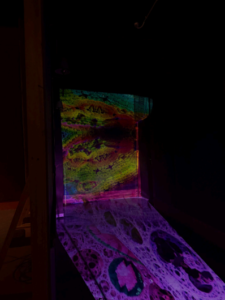
This projection mapping study focused on seamless digital-physical object collision. By projecting a generative 2D element onto a physical surface using the SurfaBeam app for real-time spatial mapping and calibration, the system subjects the digital element to real-time gravity and kinetic collision algorithms, creating the optical illusion of a digital object physically interacting with real-world geometry.
The Brief
Design and deploy a spatial projection system using mobile-first mapping software to simulate realistic physical dynamics, demonstrating how lightweight digital elements can believably interact with real-world objects in physical space.
What We Did
SurfaBeam Projection Mapping Setup, Spatial Calibration, 2D Physics Simulation, Kinetic Collision Logic, Environmental Alignment.
Technology
- Mapping Software: SurfaBeam App (Precision Mesh Warping & Surface Alignment) ● Hardware: High-Lumen Projector
- Engine: Real-Time Physics Engine
- Logic: Custom Collision Masking & Spatial Geometry Mapping
Goal
Demonstrate convincing digital-to-physical interaction by accurately simulating kinetic physics, gravity, and object collision on real-world surfaces through SurfaBeam-driven projection mapping.
Process
- Spatial Environment Calibration:
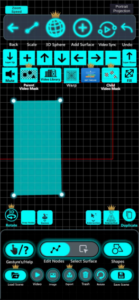
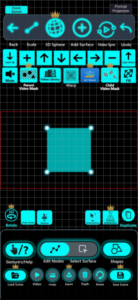
Mapped the physical environment and surface contours using the SurfaBeam app to establish precise spatial boundaries, corner pinning, and surface warping, ensuring exact registration between the projected output and real-world target objects. 2. Physics Engine Integration:
Engineered a custom physics framework simulating natural environmental forces,
including gravitational pull, velocity curves, decay, and surface restitution (bounce coefficient).
- Collision Surface Masking:
Defined spatial coordinate masks inside SurfaBeam corresponding to the edges and planes of physical objects, translating physical obstacles into digital collision boundaries. 4. Dynamic Rendering & Path Tracking:
Programmed a minimal visual entity (a geometric sphere) to travel across the mapped surface, dynamically calculating trajectory shifts and momentum conservation upon impact with masked real-world coordinates.
- Optical Alignment & Real-Time Execution:
Fine-tuned latency and visual framing within the SurfaBeam interface to align digital contact points with physical surfaces, eliminating visual bleed and perfecting the illusion of tangible bounce behavior.
Benefits
- Rapid Mobile-First Deployment: Utilizing the SurfaBeam app allowed for quick on-site calibration and live iterations without heavy media server infrastructure.
- Augmented Spatial Depth: Transforms static physical environments into dynamic interactive surfaces without changing physical infrastructure.
- High-Fidelity Illusion: Precise kinetic modeling tricks human visual perception into reading projected light as a tangible physical object.
- Flexible Environmental Integration: SurfaBeam’s mesh masking and custom physics pipelines adapt seamlessly to any physical surface or structural architecture.
Features
- SurfaBeam Precision Mapping: Multi-point surface warping and real-time mesh adjustments directly calibrated for real-world geometric targets.
- Real-Time Surface Collision: Digital elements dynamically bounce off real-world objects rather than clipping through them.
- Kinetic Physics Simulation: Accurately renders gravity, mass, acceleration, and bounce dampening in real time.
- Spatial Coordinate Mapping: Aligns digital projection grids to match real-world physical geometry with sub-centimeter accuracy.